



Surfers do not get tired to argue, where is the best place to catch a wave. In different regions the different tides. From school course is usually remembered only that the nature of the tides somehow are influenced by the Moon. Let’s try to understand what is happening. The moon, closest to Earth really has the greatest impact. But not only from the moon affects the tides. The sun around which revolves the system Earth-Moon also has an effect. Our star is 27 million times heavier than the moon, but it is also 400 times further away. Together with the Moon, the Sun creates a complex system of gravitational fields, which form the gradient of gravity around the Earth. This ensures that all items prechewed to the surface. The moon affects not only the facing side of the Earth, but to the opposite. The line of action remains the same, changing only the vector.
The same applies to the Sun. During the day portion of the surface of the Earth facing the moon or to the Sun changes constantly. The moon also rotates around the Earth and its position relative to our planet and the Sun also changes throughout the lunar cycle (the cycle length is 29.5 days). The system Earth-Moon rotating around the Sun in elliptical orbit, so the mutual arrangement of the three objects relative to each other is constantly changing throughout the year.
We see the result of the impact of gravitational forces in the form of tides different periodicity. For the same reason, we observe a second type of tide is mixed. Mixed tides show two peaks of different heights and two different minimum. To better understand the nature of the tides need to take into account several aspects. The so-called semidiurnal tides occur twice a day and have about the same size.
These tides due to the fact that the angle of inclination of the orbit of the moon relative to the earth’s equator is about 28 degrees. As a result, for some regions the relative position of the planes of the Sun and moon equalizes external impact on the Earth on both sides of the planet. In addition the topography of the Earth’s land surface makes the mechanism of the tides is much more complex. Especially if we are talking about large portions of land continents.
Small continental shelf with a broken coastline and complex differences in depth violates the free movement of water during the deep ocean tides. Due to the delay and the convergence of the waters in the streams of the tide can enhances tidal fluctuations (up to forty times). When all factors (inclination of the orbit of the moon, the coastline of continents, etc.) are combined, a burst is observed only once a day and is called stockum. Such tides occur less often.
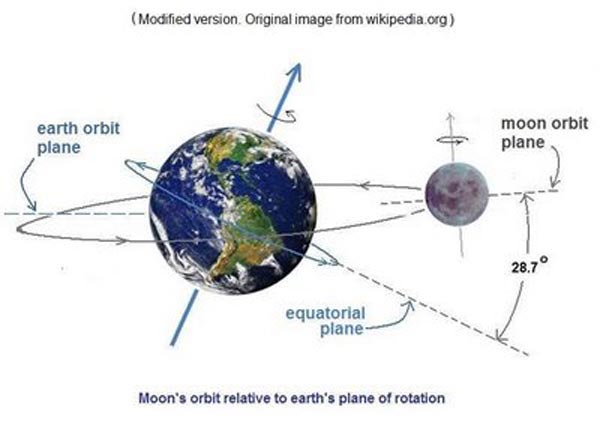
Рисунок 1: Наклонная лунная орбита.
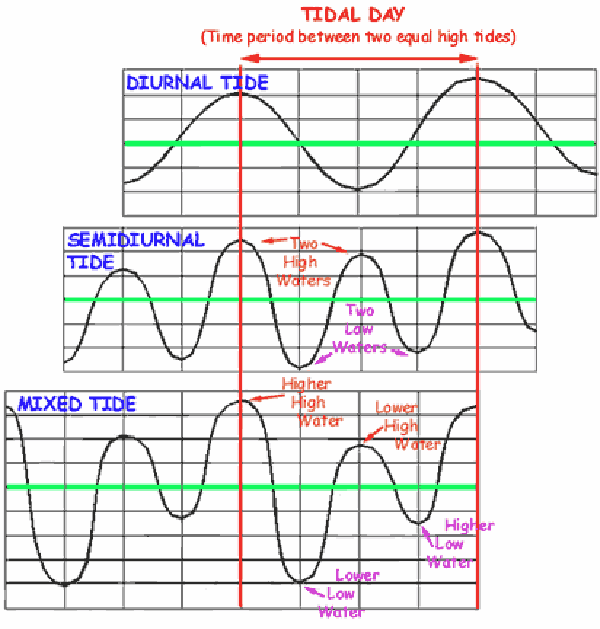
Рисунок 2: 3 типа приливов.
Рисунок 3: Приливы по всему миру.


Leave a Reply